

Written by: Ameer Ali
Every evening at precisely five o’clock, Thomas made his way down the familiar path that curved through the old city park. The rhythm of his cane against the cracked pavement echoed softly, blending with the rustle of dry leaves dancing around his worn shoes. The park, now touched with the faded colors of late autumn, had once been vibrant with life. Children played, couples strolled, and laughter filled the air. But now, it was mostly quiet—much like Thomas himself.
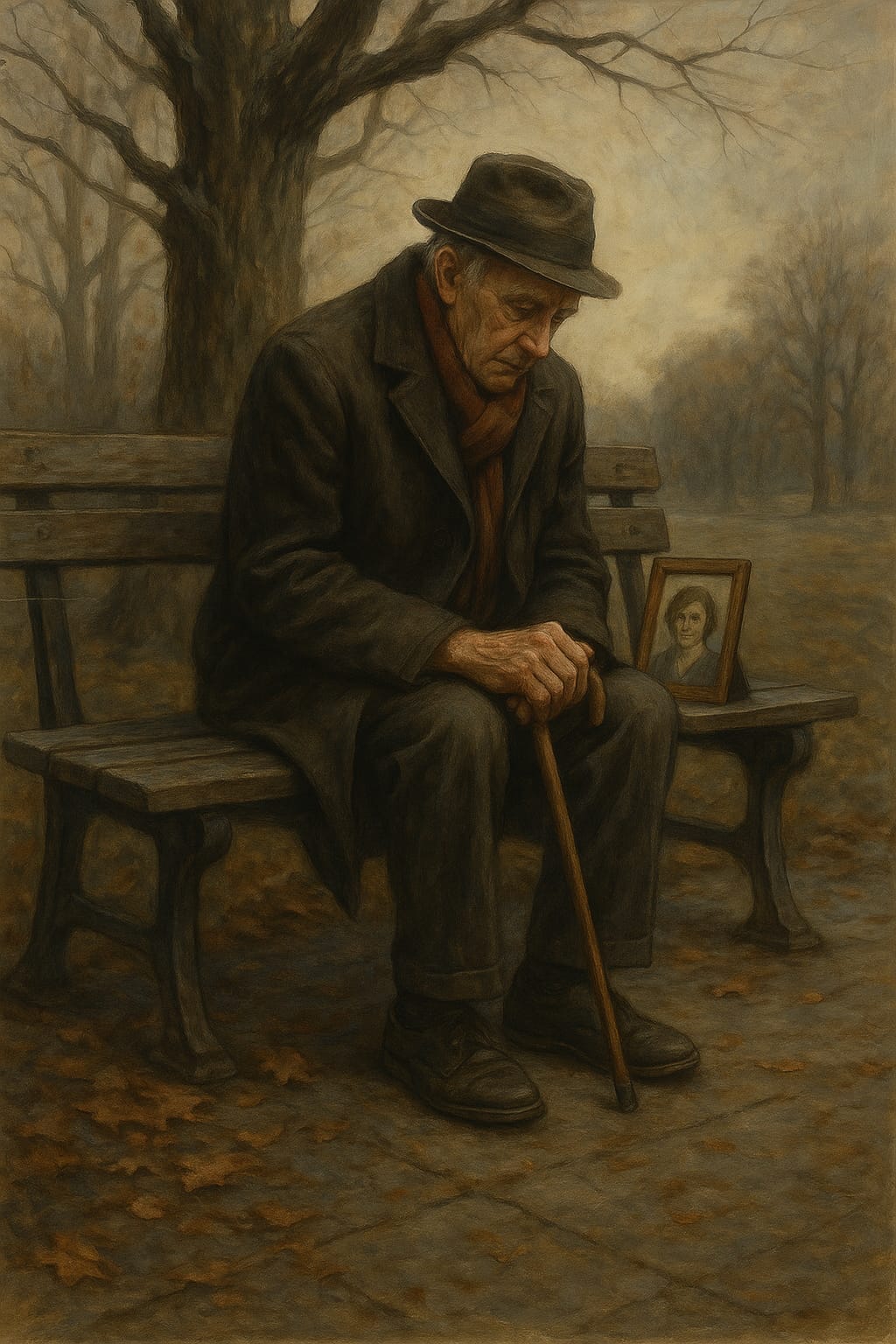
At the far end of the park stood an ancient tree, gnarled and leafless, its crooked arms reaching into the gray sky like it too was mourning something. Beneath it was a wooden bench, worn smooth by time and memories. That bench had been their place—his and Eleanor’s. For 42 years, they sat there nearly every day, rain or shine. Sometimes they talked about everything, other times about nothing at all. Mostly, they just sat. Together.
But Eleanor had been gone for eleven months now.
Gone, not because she wanted to be. Her heart had simply stopped one cold January morning. No warnings. No goodbyes. Just silence. And in that silence, Thomas’s world collapsed.
Still, he returned to the bench every day. Routine gave shape to grief.
As he reached the tree, he slowly lowered himself onto the bench. It creaked a little, like it always had. From his coat pocket, he pulled out a photograph — the last one they took together. She was smiling, her eyes still bright with youth even in her seventies, her hand resting on his. He set the photo beside him on the bench, exactly where she used to sit.
“Good evening, love,” he whispered, voice trembling. “I brought your favorite scarf today. Thought you might be cold.”
There was no reply. There never was. But he kept speaking, like she was still listening.
He told her about the cat that followed him for two blocks that morning. About the boy at the bakery who reminded him of their grandson. About the poem he’d read that made him cry. And then, he told her about the loneliness — the ache that never left, the silence in the house, the way mornings felt like cold shadows.
Sometimes, tears came. Other times, a smile.
Passersby noticed him. Some pitied him. A few nodded respectfully. None truly understood.
He never stayed long — just enough time to speak, to remember, to keep her alive a little longer in his mind. Then he would stand, kiss his fingers, press them to the photograph, and tuck it gently back into his coat.
“Same time tomorrow,” he would say softly.
Then he walked back home. Alone.
But in his heart, she always walked beside him.
