

By: Manal Rabiey
In the heart of the desert, long ago, the sculptor Thutmose stood in his workshop at Tell el-Amarna, gazing at the features of Queen Nefertiti. He was not merely striking stone; he was sculpting time itself, embedding in it the face of eternity. The bust of Nefertiti was not just a statue, but a window illuminating the divine image of beauty— a fragment of the soul, born from human hands to dwell in timeless history.
Since those ancient days, Minya— the land of Akhenaten and Nefertiti— has remained the cradle of sculptural genius, as if it were a treasury of secrets whose wellspring has never run dry. From its soil arose figures who carried the torch, such as Dr. Edward El-Gauly, a leading master of contemporary sculpture in Egypt, testifying that this land still gives birth to creators as fields give birth to harvests.
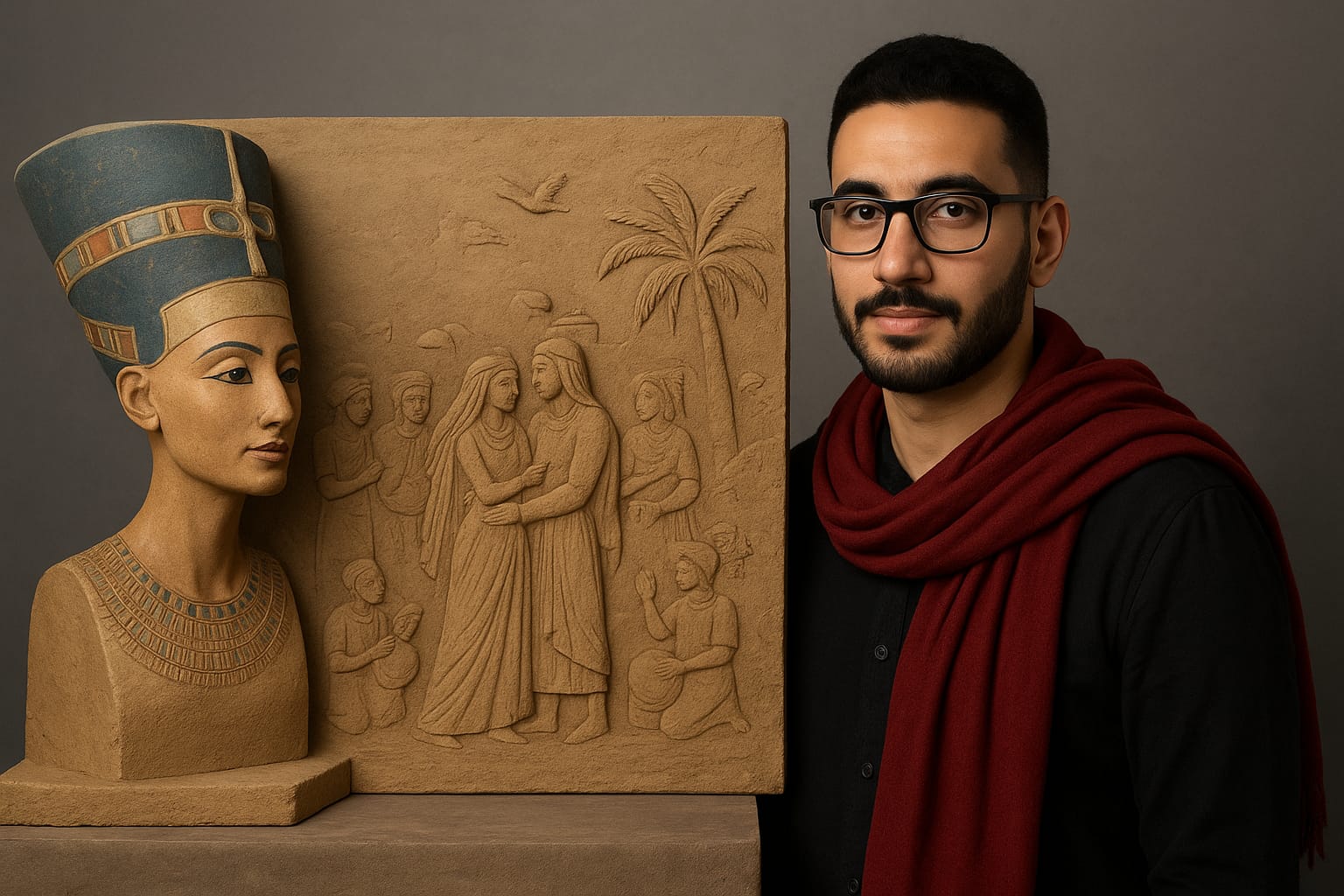
In recent years, this chain has proven unbroken. During the “Ibdaʿ” (Creativity) competition, under the patronage of the Ministry of Tourism and Antiquities, a young man from Minya, Mostafa Mohy El-Din Sadeq, revived the ancient spirit in a new language. In just three days, he shaped a work from raw Aswan clay, naming it “The Wedding Procession” (Al-Zaffa), as though he were composing a melody of life upon the clay itself.
In the sculpture, the bride appears with her long veil flowing in the breeze, beside her groom, while the people around them form a circle of joy, beating their tambourines in unbroken rhythm. Behind them rises the full majesty of the Egyptian countryside: pigeon towers reaching toward the sky, birds soaring free, palm trees and lush greenery swaying like arms of blessing. Even the bride’s veil reveals delicate folds, fluttering in the air— proof that when art is born from true hands, stone itself can breathe life.
This was not Mostafa’s first achievement. He had already created a sculpture evoking the head of Horus, the falcon god of protection and the sky, and a commemorative medal celebrating the restoration of the Avenue of Sphinxes in Luxor and the great Feast of Opet. Each work reveals that for him, sculpture is not merely an academic pursuit but a continuation of an ancient genius that began with Thutmose and his peers.
—
The Ever-Flowing River of Art
Between Thutmose’s Bust of Nefertiti and Mostafa’s “Wedding Procession”, a single thread extends: Egyptian art is not a fleeting event, but an eternal river flowing through the veins of its children. Minya, for thousands of years, has remained the sanctuary of sculpture, where beauty is reborn again and again.
In my view, there lies within this succession a hidden, almost mythical meaning— as though Nefertiti herself, with her regal veil, had stretched out her hand across time to bless the village bride’s veil in “The Wedding Procession.” Here, art is no longer a tool but a prayer, a long invocation that began in Tell el-Amarna and has never ceased.
